Trainee Profiles 2016-17
Naomi Rebis
Institute of Classical Studies/Joint Societies Library
Hello!
I've been the Winnington-Ingram trainee at the ICS Library for about two months now, and have already done so many new and exciting things that I felt I ought to write something about them before they fade to the back of my mind!
A bit about me: I graduated from Fitzwilliam College, Cambridge, in June 2015 after three wonderful years studying Classics, and found myself unsure of what to do next. During my final year, I had helped the college librarian sort a large bequest of Classics books, and was then offered a fortnight's paid work there over the summer, so library traineeships seemed the logical next step. I was very excited to come across the Winnington-Ingram traineeship, and the chance it offered to be involved with Classics again, so, although I worried I might not have enough experience for the post, I applied. And I am very glad I did!
It seems apt that I should write my first ever blog post after what feels like three months of 'firsts'. Not only has moving to London been something of a culture shock, but my new job has opened up all sorts of events and opportunities that I never anticipated. I cannot speak for other traineeships, but at ICS the whole team has been very eager to get me 'out and about' doing things, and it has definitely not just been two months processing new books in the back room!
There has been some processing, of course, but that is very good fun as it involves using stamps, several types of glue, and even a little knife to score the spine where the beetle is going to go (beetle being the in-house term for the sticker that we write the book's classmark on). Sometimes it feels a little like being back in primary school, happily cutting and sticking different things, though of course when it comes to repairing old or damaged books rather more reverence is required! I have learnt how to make an Oxford hollow (a tube of paper which you put beneath a damaged spine to strengthen it, and help the book open/close more easily), how to straighten dog-eared corners, and how to 'tip in' (i.e. glue back in place) loose pages. Being forced to cover my workbooks with sticky-back plastic in Year 7 has finally come in useful, as sometimes we use Vista-foil here to cover books and stop them getting tatty.
Other day-to-day jobs include shelving; issuing/returning books; sending out postal loans, or books for academics to review; signing people up for membership to either the Institute [reference only] or one of the Joint Societies [borrowing]; and scanning articles for readers all over the country. I also spend a lot of time directing people up to the fourth floor, as the Senate House library is just above us and that can confuse visitors. (Number one rule for when people say they want to join the library is to ask WHICH library, as you don't want to go through a whole speech about Society membership if they want to join Senate House!)
Outside the library I have been to an exhibition on ancient Sicily at the British Museum; a set of talks at IHR (Institute of Historical Research) about emerging research into Library and Information Studies (LIS); and an information day about the LIS Masters programme at UCL. The Institute has very kindly agreed to pay for me to attend a day-conference in Cambridge about historic libraries and engagement with special collections, so there is definitely huge scope on the traineeship for visits and events.
In short, I would heartily recommend this graduate traineeship to any Classicist, or ancient historian, with an interest in working in libraries. It has already been such a rewarding experience, and it is really lovely to be surrounded by Classics books all day (even if I can't read them on the job!). It is also incredibly exciting to talk with undergraduates/postgraduates/academics about their research, and be encouraged that Classics is still a living, breathing, endlessly relevant subject.

Welcome
Hello. I'm Michael Townsend, one of the librarians on the Trainee Library Committee, and I just wanted to say welcome to the new trainees for the coming academic year. As with previous trainee years, feel free to make this blog your own, maybe starting out writing a quick profile of yourself, then maybe highlighting the visits and training sessions that will be arranged over the coming year or indeed anything else LIS related that catches your eye...this is your blog!
Visit to Cambridge Libraries - 30th June 2016 - Pictures and Points
It was a miraculously sunny day in Cambridge when the graduate trainees touched down for a packed day of library tours.
 Nick explains the foundations of the old library, which was begun with a donation from the college's foundress Lady Margaret Beaufort.

 Some of the library's special collections, including first editions of Milton's Paradise Lost and Darwin's The Origin of Species


 The catalogue hall. The ornate doors leading to the reading room, as well as the building itself of course, were designed by Sir Giles Gilbert Scott, who is responsible for such famous landmarks as Battersea Power Station and the red telephone box.


English Faculty Library
Lastly, we headed to the English faculty library, where we were given an insight into the role of the subject libraries, who operate in the 3-tier library system at Cambridge where students have the option of studying at their college library, faculty library or the main university library. We were given a tour by assistant librarian David, who showed us their specialised collections and described the efforts of the team to really understand their students' research needs - which includes Tea @ 3 - a daily cuppa so that students can take a break and chat with staff in an informal environment.

Christ's College
First stop was to Christ's College library, where we were met by Christ's graduate trainee this year, Nick Butler. Nick showed us around their modern working library, as well as their old library, which contains special collections from their most famous alumni, including Charles Darwin's letters and a first edition of Milton's Paradise Lost.


Joseph explores the annex!

University Library
Next we headed to the main University Library, which this year is celebrating its 600th birthday. Here we met Claire Sewell, Research Skills Coordinator, who led us around the warren of reading rooms, basements, and most excitingly, the library's famous 17 storey tower, which holds the legal deposit material of yesteryear - mainly trashy Victorian novels. Claire explained the challenges that legal deposit libraries face today, with the amount of publications they receive rising every year.


Interior of the main reading room

Trainees come back down to earth after their trip up the tower
Corpus Christi College
After lunch in Market Square we headed past the the Corpus Clock - which is known as a 'time eater', intended to remind you of your own mortality, and on to the beautiful interior courtyards of Corpus Christi College. Corpus has two libraries, and it was to the Taylor Library first, a modern, open-plan library space first opened in 2008, where we were shown around by librarian Rebecca Gower. They allow 24 hour access and are equipped with group study rooms, a media suite and bean bags!
Across to the Parker Library, so named for the college's benefactor, Archbishop of Canterbury Matthew Parker, whose collection of over 400 manuscripts left to the college makes the library one of the greatest treasure troves for medieval manuscripts and early printed books in the world. Librarian Beth Dumas showed us around and explained the extensive preservation work required for these rare materials. She and her colleague also manage Parker on the Web - a digital library of every imagable page of almost every manuscript in the Parker Library, and build bibliographies for all the items in the collection. We were lucky enough to have time to see the current exhibition, which currently has on show gems like the Anglo-Saxon Chronicle, and one of Anne Boleyn's letters.


Upstairs at the Parker Library
English Faculty Library
Lastly, we headed to the English faculty library, where we were given an insight into the role of the subject libraries, who operate in the 3-tier library system at Cambridge where students have the option of studying at their college library, faculty library or the main university library. We were given a tour by assistant librarian David, who showed us their specialised collections and described the efforts of the team to really understand their students' research needs - which includes Tea @ 3 - a daily cuppa so that students can take a break and chat with staff in an informal environment.

British Library Tour and Presentation - Tuesday 26th April 2016
Our visit started with a friendly
welcome from BL staff members, Adrian Shindler (Humanities Reference
Specialist) and Kelvin Eli (Collection Storage Manager). Upon receiving our
visitor passes in the Front Hall, we were taken down to one of the underground
basements to observe how the Library goes about storing its printed materials.
The space is vast and contains rows and rows of open shelving used to store items
in high demand, while rolling-stacks are used to store items in slightly less demand.
The basements are all temperature and
humidity controlled environments, so materials stand a much better chance of
being preserved for the benefit of future generations. The basements also run
in close proximity to the Victoria line (London Underground), and the rumble of
the tube trains can be heard on a frequent basis!
Inside the Operations Room, staff
constantly receive new requests for materials, which they must pick and scan before
sending up to the Reading Rooms. To this end, staff rely on a network of
conveyor belts to transport materials from one part of the building to another.
Kelvin drew our attention to the fact the Library takes anything between 1100
and 1300 requests per day. Overall, it struck me very much as a system comparable
to a modern warehouse setting, compounded by the efficiency with which the
whole operation was carried out – registered BL readers will know the Library
sets a 70 minute deadline for the majority of requests to be processed.
During the tour we walked past multiple
trolleys filled with early printed books. These, we were told, were being sent across
to Germany to be digitized as part of the BL’s joint project with Google Books.
According to Kelvin, approximately ten thousand out-of-copyright books are sent
to Google every month. We also spent time in the Library’s sound collections, which
featured all sorts of recordings available through an impressive array of different
formats: 19th century wax cylinders, acetate discs, oversized LPs,
cassettes, CDs, MiniDiscs, and so forth. Similarly, we spotted film reels,
Betamax, VHS, DVD, and Blu-ray formats for audio-visual recordings related to
drama, poetry, and literature in performance, as well as the moving image in
general.
After the tour concluded, we were
introduced to Hedley Sutton (Asia & Africa Reference Team Leader), who
presented half a dozen or so highlights chosen from the Asia & Africa Collections.
Firstly, we looked at an incunable with contemporary world map illustrations produced
just before the discovery of the Americas. Elsewhere, we glanced through a 19th
century Indian textiles catalogue; an 18th century East India
Company ship’s log; an early printed book devoted to the legendary Christian
King, Prester John; and a 20th century colonial officer’s ‘recreational
guide’, entitled The Hoghunters Annual.
The presentation was extremely interesting and demonstrated the research
potential to be gained not just in rare books, but all kinds of ephemera too.
The final part of the afternoon
was spent inside the Asia & Africa Reading Room, which fits around ninety
people in total, and is considered one of the more pleasant spaces to work,
mainly due to the selection of portraiture paintings on display. Many thanks to
Adrian, Kelvin, and Hedley for taking the time to show us around the Library
and for their erudite responses to our questioning.
The British Film Institute Tour - Tuesday 8th December 2015
The London Research Library Trainees where given a tour of the British Film Institute (BFI) Reuben Library by Sarah Currant, Librarian for Reader Services. After a short explanation of the small but well-designed reading room, Sarah discussed the library and her own career. The Edwin Fox Foundation Reading Room has six public access computer terminals with access to the BFI’s Collections and Information Database (BFI Screenonline, BFI InView and the FIAF database). As a research library, the BFI uses onsite access to uphold copyright restrictions. Sarah stated that she is surprised that these computers are not used more, because of the wonderful material that can be viewed on them. Users also have the opportunity to use three digital scanners to retrieve information held on microfiche and roll film.
The
library collection is 81 years old and one of the largest written collections
on film and television in the world. The Library, notes as a point of pride,
that their oldest material is older than the BFI National Archive, which is
sometimes recognised as a more prestigious counterpart. The library holds 5,000
serials titles and over 200 current titles with worldwide coverage. Sarah
joked, that you wouldn’t believe how many journals are just called ‘film.’ The
Library has 45,000 books, and acquires around 1,000 new titles per
year.
The
BFI Collections Information Database (CID) contains information collected by
the BFI since 1933 and holds over 800,000 film titles (including television
programmes, documentaries, newsreels, as well as educational and training
films). Although CID is updated daily, less than 50% of listed titles are
actually represented in their physical collection. The collection is roughly
20% open access, and around 55% in total is held at the BFI Southbank. The
remaining 45% of the collection is held offsite at the J. Paul Getty Jnr
Conservation Centre in Berkhamsted, Hertfordshire. The Library is open from
Tuesday to Sunday between 10:30 - 19:00, the enquiry desk is man by 2 people at
all times and has 3 separate timetabled shifts.
The
Library is available for private hire and has produced events such as the Salon Discussion: Writings on Artists' Moving Image (Monday 11 January
2016) and Jean-Luc Godard as Architect (Wednesday 13 January
2016). The Libraries next event is Flare at 30 a lively illustrated talk
celebrating 30 years of the BFI Flare: London LGBT Film Festival (29th February 2016). This
is to make some small profit and illustrate a further integration with the rest
of the BFI.
Sarah
stated that the BFI had recently gone through a change project, after major
cuts in funding, but that this had led to many positives. The move to the
Southbank complex had made the Library more central to the institutions goals
and had changed its customer base. With access now free to the library, visitor
statistics have dramatically increased. With annual visitor targets, the BFI
gets over 70,000 people through the reading room doors per year. Due to the
relocation in June 2012, the BFI is now getting more students from Kings
College than Birbeck and UCL. Sarah noted that many users were students that
simply wanted a quiet place to work in central London, rather than specific
information about film. As a small library with only 50 TipTon chairs, 30 for
library users, and another 20 users for specialist research, Sarah feels it
would be very difficult to reduce numbers based on an interest in film material
if the library ever got too full.
Sarah
mentioned that the library does take a series of statistics to illustrate its
cost effective nature, and was looking into the possibility of creating a world
map that indicated the distance that some visitors have gone to see the
library. However, she did state that the library does not have membership
cards, and gets visitors to fill in daily registration cards to count stats.
Having started at the
BFI in 2005 from the Foreign and Commonwealth Office Library, Sarah advised
students to focus on taking broad MA’s that encompassed aspects of information
management and digital systems to give them the best opportunity when applying
for jobs.
Tour, tea and talks at the Institute of Advanced Legal Studies – 8th March 2016
“You think you'd
like to play ball with the law?” – Bob Dylan*
The Institute of Advanced Legal Studies (IALS) has been
housed in Charles Clore House since 1976, a long, brooding, Brutalist building
designed by National Theatre architect Sir Denys Lasdun. The institute itself
has been around since 1947. Four dedicated graduate trainees made their way to
Russell Square on a chilly-but-bright Tuesday afternoon for what promised to be
an interesting afternoon in the hands of legal librarians.
The library entrance being on the 4th floor,
it’s there that we met Access Librarian Lisa Davies, who started off the visit
by giving us a 30 minute tour of the place. Split over four levels, the library
stocks around 180,000 volumes. This is split between primary legal material and
secondary legal material, the latter being interpretations or commentaries of
the former. Their own in-house classification system orders these works based
of geography or subject, meaning that not all books on a certain topic will be
found in the same area – this a not a library for the casual browser. As well
as books (in the broadest sense of the word), they also have a significant
range of legal journals from around the world.
The reading rooms are situated on the lower ground floor
(L2) up to the third floor, accessible through an internal lift. The 4th
floor holds the issue desk, photocopying room, library offices and a large open
access computer lab where users can access the internet and the library’s 70+
online and subscription-based databases. Although a lot of primary legal
material is becoming available online, the library has a duty to collect and archive
printed versions as well, and so provides both.
We were briefly shown the (stiflingly) warm reading rooms
with their utilitarian-looking desks and exciting views of Russell Square and
beyond. As well as normal work spaces, PhD students can rent a so-called carrel
– a small, private office with desk, lockable drawers, lamp etc. – for a small
weekly fee. Users of the IALS library are around 95% PhD/post-doctorate
students, institute staff or students from the University of London colleges,
but law firms can also pay a one-off/annual fee to use the library.
After the tour, it was off to the staff common room for a
cup of tea and chat with Lisa about her career and role as Access Librarian, a
role dedicated to promoting and improving access to the library through
advertising, outreach and off-site support. It was here we met one of the IALS
GTs too, Jamie.
Cups of tea aside, we made our way back to the librarian
offices for a quick talk about what the IALS library does to meet the
requirements of the Disability Discrimination Act 1995. We all contributed
thoughts about how our own libraries meet the requirements of the act, or don’t
in some cases, and discussed services that could be offered to users with
disabilities. It was a useful, thought provoking talk.
The final stage of the visit was a talk from Helen Gaterell, Document Supply Supervisor. The IALS operates a profit-making
document supply service. The income from the service is re-invested into improving the academic library collections and services. There are two types of service on offer: standard (dispatched within
the day: £21.80) and express (dispatched in under 60 minutes: £43.60).
Subscribing practitioners/firms or academics will contact the library seeking
extensive copies of articles, cases or chapters from volumes held in the
library. These are then found, photocopied, scanned and sent to the respective
client to be used, on the whole, in court cases. Interestingly, there is
currently a large demand for material on Nigerian law, as, according the Helen,
there are lots of corporate cases involving Nigerians and Shell/BP taking place
at the moment.
And that was it! All over in a couple of hours, I felt
like we’d learnt a lot about a very (to me at least) unusual library. Although
I have no personal interest in playing ball with the law, I found the library’s
space surprisingly appealing, and the services on offer seemed well run and
efficient. Overall, an intriguing and enlightening trip!
*"Hurricane", Bob Dylan, http://bobdylan.com/songs/hurricane/
N.B.: Feel free to email the above mentioned librarians for more information!
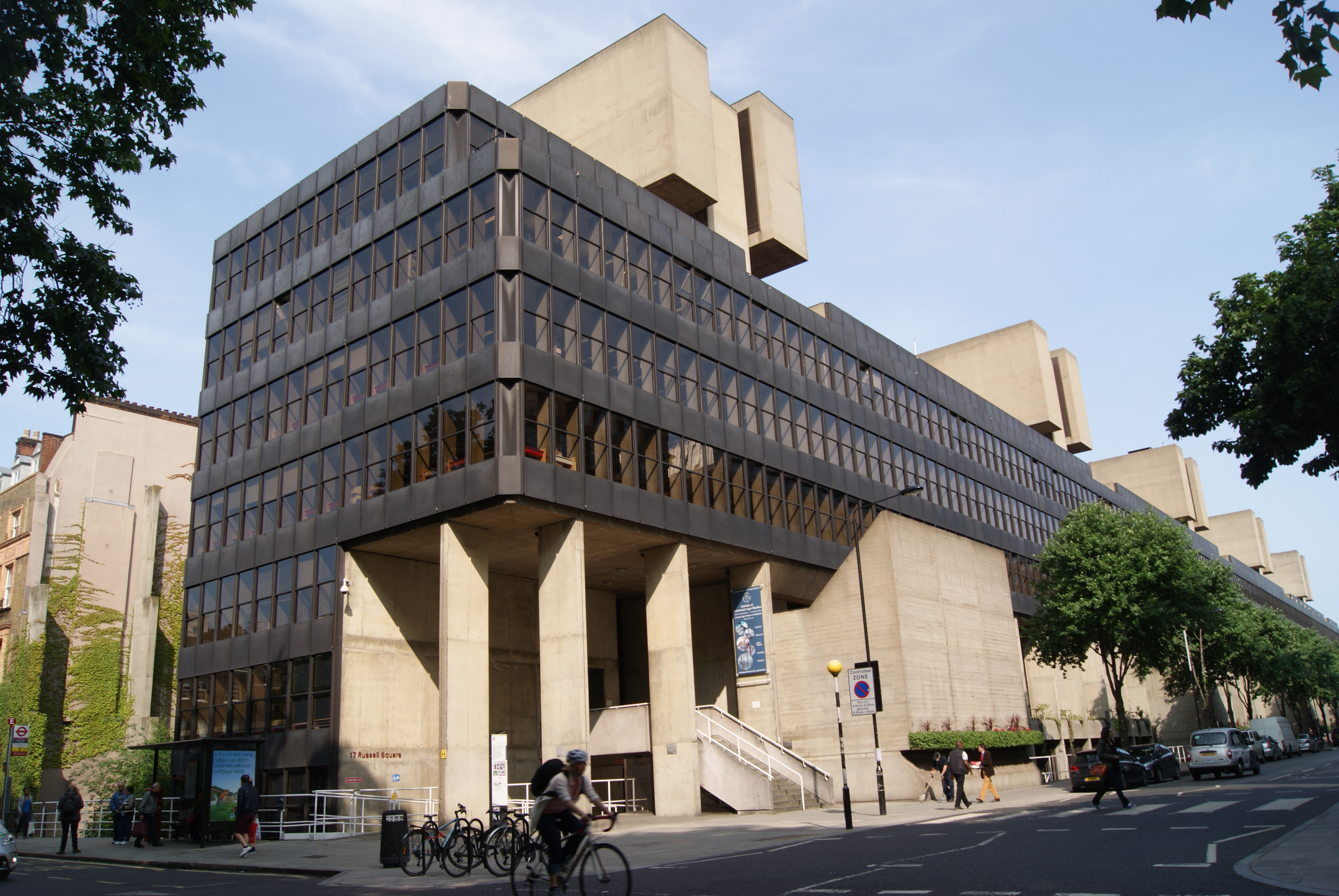 |
| Fig. 1: IALS, smuconlaw, https://en.wikipedia.org/wiki/Institute_of_Advanced_Legal_Studies |
Visit to the Guardian - 14th December 2015
On Monday 14th December, a group of the trainees
were fortunate enough to visit the headquarters of the Guardian Media Group and
meet with both the library and archive teams.
The Manchester Guardian was founded in 1821 by John Edward
Taylor and gained national and international acclaim under the editorship of C
P Scott who held the post of editor from 1857 to 1914. In addition, Scott
bought the paper in 1907 following the death of Taylor’s son and as we learned during
the course of our visit, the Scott Trust still maintains ownership of the paper
today. The paper moved to its current building in King’s Place near to King’s
Cross station in 2008, with the glass-fronted, open plan office space and
modern design marking a significant shift for the newspaper.
Upon arrival we were met by Philippa Mole, Acting Head of
Archive, who led us on a tour of the building, including the exhibition space,
reading room and the photographic and print archive stores. During the tour of
the archive, we were able to view a selection of the incredibly eclectic
objects kept within the stores. These ranged from negatives of the Beatles,
notebooks of renowned Guardian cartoonists, an early example of a ‘laptop’ (the
Tandy portable computer from 1983), Betamax film rolls and photographs of an
array of famous historical figures. The archive also contains, somewhat surprisingly
and initially rather alarmingly, an array of miniature coffins used to mark
significant moments over the course of the paper’s history (for example,
Philippa explained that a mock funeral was held in 1987 to mark the end of hot
metal printing at the newspaper. Crowds of staff turned out for the event, with
the pallbearers even donning top hats!)
In addition, Philippa also took time to explain the
day-to-day tasks involved with the running of the archive service. The archive
holds official records of both the Guardian and the Observer newspapers, as
well as acquiring material from people who have been associated with the
papers. As Philippa explained however, the archive does not actually contain
the newspapers themselves. She noted that the archive deals with a broad swathe
of inquiries both internally and externally from private researchers and
students. Additionally, the role of the archive team includes creating web
resources, writing blog posts, organising tours of the archive for staff and
arranging outreach activities.
The archive’s trainee Helen and Information Manager Richard
Nelsson, also took time to speak with us and explained their respective roles
within the archive and library teams. Richard provided a fascinating insight
into the role of the library department, explaining how the team conducts
background research for interviews, collates reports for publication departments,
produces content for both the print newspaper and online edition, create
timelines, attach corrections to articles in the newspaper’s internal database,
and compile the daily birthdays column.
Al three kindly answered several questions from the
trainees, with topics ranging from if there was a need to justify the existence of a
library team within a news media organisation, to electronic data subscription
services and the number of research enquiries the team receive. Philippa noted
that we were welcome to contact
her with any further queries we might have and kindly provided us all with a free
copy of the day’s newspaper!
Many thanks once again to Philippa, Richard and Helen for
devoting so much of their time to helping us get to know both a fascinating
archival collection and understanding the role of libraries and archives within
the media sector. The insight we gained was truly invaluable and will be of
great assistance as we all begin to embark on our careers into the sector.
For further information about the Guardian Archive and the
work of the Library Team see:
Subscribe to:
Posts (Atom)