Hello, I’m Ceri, I’ve been at the Institute of Historical Research Library as a Graduate Trainee Library Assistant for just over four months. Before joining the IHR, I was a residential library intern at Gladstone’s Library for 13 months. As a history graduate, the chance to be surrounded by history and to work in a historical building is a dream come true. The building is a grade II listed building in a beautiful Art Deco design, something that still takes my breath away every time I come to work and look up.
When I first graduated I was unsure whether I wanted to work in museums, with archives or in a library. I gained experience doing all three! But to me a library is something that has always calmed and excited me – one of the main reasons I wanted to become a librarian is not just because of my love of books, but mainly because of the love I have for helping people. One of my main responsibilities is helping people finding the correct information, or to use resources within the library.
In the IHR library you can find antiquarian books housed with modern books. Another aspect of my job is ensuring books that get left on the desks go back to their own shelf. I like seeing what people have been reading, but also getting to explore the collections by looking at the shelves. When I was in university I loved using the library to research and also shelf browsing – finding similar books that might be useful to my research. Getting to browse and tidy the shelves for my job is my idea of heaven.
My favourite aspect of the job apart from being surrounded by books – is that no one day is the same – I can be rebinding, reclassifying, cataloguing, helping someone with their photocopying, finding information they need, scanning books for virtual learning or interlibrary loan or having a book adventure in the tower (our onsite storage facility). I also get to buy books for the library – at the moment this is supervised and is testing my German language strength but eventually they will trust me to choose books for the collection – I will get to leave my own mark on the library! I am also involved in promoting the library – this can involve anything to writing blog posts, helping to set up an exhibition to promote the library collections, or adding social media posts. Promotion often leads to another chance to explore the collections – finding for example an inscription from H.G. Wells or discovering other treasures in the collections.
As part of the traineeship, I have also been encouraged to attend various courses and conferences such as the CILIP new library professionals’ day, the Internet Library International Conference, the library has kindly paid for me to travel to Manchester to attend a Rare Books and Special Collections conference and also attend an applying to Library School Day, as well as a variety of other courses such as one on social media. I have also been to a various seminars held here at the Institute of Historical Research and at the Warburg Institute.
This traineeship is allowing me to gain experience, to receive support and training. As well as meet up with the other London trainees and gain support and a chance to discuss our experiences with each other. As a Welsh person, moving to London for this traineeship was an extremely daunting task but I have loved every second of it so far. I feel I am continually learning and have been heartily welcomed into the small team here. I’m not sure whether I want to continue to live in London next year, study part-time or full-time, but I’m certainly in the right place to gain support and advice regarding those decisions. I would recommend anyone who is looking to gain more experience in librarianship to consider the Graduate Trainee Programme!
Farewell, Molly Richards
The Library staff would like to thank Molly Richards for the time she spent with us as a trainee librarian (August 2017 - January 2018), and wish her all the best in her new post working at the Oxford English Dictionary.

Visit to the British Museum Libraries - 27th April 2017
Our latest library visit brought us behind the scenes of the British Museum. Not many people realize that the museum houses not only around eight million objects but nine libraries as well. We had the opportunity to visit four of them.
Starting in the Great Court we first were pointed towards the remainder of the library which is usually most famously associated with the British Museum, the Reading Room. It used to be the main reading room of the British Library until both institutions were formally separated in 1973, and the library moved to its new purpose-built location near St Pancras. Currently the Reading Room's future is still being determined but there are plenty of other functioning library resources within the museum offering alternative spaces to read and study.

The first stop on our tour was the Anthropology Library and Research Centre, located near the museum's north entrance. Formed through the amalgamation of the British Museum's Ethnography library and the library of the Royal Anthropological Institute, it is now one of the world's major specialist anthropology libraries, containing over 120000 volumes. The collection is particularly strong in material culture and its global outlook. With holdings stretching back to the sixteenth century, the collection developed roughly in sync with the evolution of the field of anthropology in Britain during the late eighteenth and nineteenth centuries and continues to be expanded with current publications. It features many books of collectors for the museum, including original travel accounts by European explorers and settlers in Africa, North and South America, Asia and Oceania. Among them, you can find curiosities such as a little book titled: "The hairy giants: or a description of two islands in the South Sea, called by the names of Benganga and Coma [...]" from 1766 narrating a (possibly imaginary) discovery by Henry Schooten. The library will also assist in upcoming projects in the collaboration between and British Museum and the Google Cultural Institute, so check back in future for further updates.

Next we were led to the Asia Library, which is only accessible to museum staff and managed by only one librarian. We were given some valuable insight into what it is like to the the sole librarian in a museum library. The position involves a lot of overlap between library and archival work with a high focus on research and collection curation. Although the job is usually quite secluded, the librarian also serves museum curators and at times external researchers who utilize the library to support their research. At the end of the presentation, we were challenged with a very useful cataloguing exercise, in which we had to spot
mistakes in catalogue records using examples from the collection ranging from Chinese lacquer to East Asian propaganda posters.


The library of the department of Greece and Rome was the final stop on our tour. The main function of the library, as with the ones before, is to hold books relating to the museum's collections to aid its curators. At the same time though, we could also see a strong glint of institutional history in the items we were shown. For example, the library holds extensive correspondence from previous collectors, curators, librarians and researchers, which show a history of the library's and the museum's collection development and its interactions with the public.
My main thought when we had completed the tour was that it is a great shame that these libraries are not more well known. They are an important resource and support service to one of the UK's major cultural institutions and form an integral part of its institutional history. The visit made me appreciate another layer of the British Museum beyond its objects and exhibitions. There are multiple important services behind the scenes that we often don't even consider. I was prompted to think differently about how libraries are used too. In my mind (and possibly in most other people's) the library user is someone who mainly consults textual materials and reproductions of non-textual materials. Museum library users are able to view textual and material cultural items in one space to increase their understanding of what they study, creating a more intimate relationship between the text and object than is usually found in most humanities disciplines. This is part of the great benefits of our visits: being able to consider and compare our experiences as new librarians in relation to the vast landscape of all kinds of ways libraries can be used and how librarians adapt to that.

We were then escorted to the Coins and Medals Library, one the world's leading numismatic libraries with over 20000 books, 600 journals and a wide range of pamphlets and sales catalogues. Running over three floors is covers numismatics and economics from across the globe. Access is by request only for numismatic researchers and the library is also used by the staff of Coins and Medals department to consult the books alongside the coins in the collection. How this simultaneous consultation of both textual and material collections works in practice was demonstrated to us by one of the curators of the department, specializing in coins from the Middle East. Combining the historic coin collections from early Islamic times with a modern book of engravings documenting Middle Eastern coinage from different periods, we were able to identify matches between the two.

My main thought when we had completed the tour was that it is a great shame that these libraries are not more well known. They are an important resource and support service to one of the UK's major cultural institutions and form an integral part of its institutional history. The visit made me appreciate another layer of the British Museum beyond its objects and exhibitions. There are multiple important services behind the scenes that we often don't even consider. I was prompted to think differently about how libraries are used too. In my mind (and possibly in most other people's) the library user is someone who mainly consults textual materials and reproductions of non-textual materials. Museum library users are able to view textual and material cultural items in one space to increase their understanding of what they study, creating a more intimate relationship between the text and object than is usually found in most humanities disciplines. This is part of the great benefits of our visits: being able to consider and compare our experiences as new librarians in relation to the vast landscape of all kinds of ways libraries can be used and how librarians adapt to that.
If you would like to know more about the British Museum and its libraries, the museum offers information on its page for its libraries and archives and you can consult all of the libraries' collection via their catalogue.
Visit to the London Library - 15th December 2016
Our last visit of 2016 led us to
the London Library. Tucked away just a few minutes’ walk from the hustle and
bustle of Piccadilly on St. James’s Square, the London Library is what many
avid readers and librarians would most likely call their “dream library”.
Originally an old town house, extended over the decades to accommodate its
rapidly growing collections, the library is full of picturesque reading rooms
with old wooden furniture, comfortable armchairs and balustrades for, of
course, more books. It is also probably one of the only libraries that still
maintains its book lifts. The library opened in 1841 and was
envisioned by its founder, Scottish author, historian, and biographer
Thomas Carlyle, in contrast to the then often overcrowded and reference-only
British Museum Library. Carlyle wanted to create a subscription and lending
library where readers could join for a membership fee and read or study in a
tranquil, comfortable atmosphere as well as borrow books to read at home. Now members are able to read a vast
variety of over one million books, mainly on arts and humanities subjects, ranging
from the sixteenth century to the present day, across 2000 subjects and in 55
different languages with about 8000 new acquisitions made annually.
 |
| One of the book lifts in the London Library |
Caring for such a large and
historically significant collection while allowing most of it to be open access
and borrowed is no small task. So it seems appropriate that we were first
ushered to the conservation studio, where the team’s current project is to
implement preventative conservation techniques by packing old and fragile
books into specially made preservation boxes tailored to each book’s individual
size to prevent exposure to light, dust, pollution or other wear and tear.
Afterwards we were led to the Victorian grille-floored book stacks which run
over four floors and form part of the structure of one of the first
steel-framed buildings in London. Dating from the 1890s, they were a then
great innovation in the construction of libraries to aid with ventilation and
temperature control.
 |
| The Victorian Stacks of the London Library |
Here we were also introduced to
the library’s unique classification system, invented by Charles Hagberg Wright,
who was appointed as librarian of the London Library in 1893. He set out to aim
for a good balance between readers finding what they were interested in while
allowing for browsing and serendipitous finds. Some sections we found included:
a section for every King Charles you could think of, epigrams, and cheese. The
classification system was particularly interesting to me because the library in
which I am completing my Graduate Traineeship, the Warburg Library, has a
similarly idiosyncratic way of sorting its books. In the Warburg Library we talk about
the concept of the “good neighbour”, in which books are grouped to aid
researchers to serendipitously find the book they did not know they were
looking for and which could provide them with a key new insight into their
field.
While being led through the many rooms and floors of the library, including the
famous Victorian Reading Room, we encountered further interesting features. One
of them was the Small Books Cabinet, in which around 350 books measuring up to
5 inches tall are kept, so they do not disappear between their larger
companions. Another was the enormous, multi-volume bound catalogue (now
supplemented by a digital version) of the library and the so-called Times Room
in which the back runs of hundreds of
periodicals, including original copies of over 200 years of the Times newspaper
are stored.
 |
The Small Books
Cabinet
|
While exploring the library’s
many corners, our guides illustrated the London Library’s history for us. The
London Library has had a lively history with many illustrious patrons and
readers to people it, including T.S. Elliot, Charles Dickens, Virginia Woolf
and other giants of the literary world, which gave the staff a rich canon
of narratives to pass on to us. One we were told was how T.S.
Elliot presented a hand-written manuscript of The Wasteland for auction to help fund the London Library to pay a tax bill from Westminster Council after it had been
incorrectly classed as a “gentlemen’s club” rather than an educational institution.
Another was about how library staff actually lived in the library during the
Second World War to be prepared for immediate on-site rescue action should the
library be bombed (as indeed it was in 1944 destroying over 16000 volumes). Its
history with its many eccentricities is part of the essential character of the
library and what makes it so appealing.
As a Library trainee from an
academic research library, it was very worthwhile seeing how a historic, independent
lending library differs in its nature, particularly in terms of its readership,
membership policy, collection policy and funding structure. Thank you to Amanda
Corp, Head of Enquiries, and Amanda Stebbings, Head of Member Services, for the tour and for answering our questions afterwards.
For more information on the London Library, you can visit
their website here: http://www.londonlibrary.co.uk/
Trainee Profiles 2016-17
The Institute of Historical Research
Tundun Folami
Hello, I’m Tundun, the
new graduate trainee at The Institute of Historical Research Library. Before
starting the traineeship in September, I was a Library Customer Service Officer
at Barnet Libraries. I graduated from Kingston University in 2015 with a degree
in International Relations with French, and like many others, considered many avenues
after graduation such as the Civil Service, teaching and further study. In the
end, my positive experience with the academic liaison librarians at my
university as well as my experience of working in a public library led to my
decision to become a librarian.
So far, I am really
enjoying being a trainee. 10 weeks in and I am now overseeing a range of daily
tasks. A typical day consists of shelving, fetching requests from the onsite
store, checking the library’s social media accounts, answering enquiries and
French acquisitions. I also help with cataloguing and reclassifying the Latin
American and North American collections, book conservation and repairs and
creating research guides to the collections. This has involved a fair amount of
research, locating books and journals, and definitely tests the limits of my
language skills from time to time. It has taken quite a while to settle in and
get used to new library systems, collections and readers, but I am definitely
starting to get to grips with what it means to be a ‘real’ librarian.
What is so great about the traineeship is that as well as
receiving a great deal of support and training internally, we are also
encouraged to attend courses and visits throughout the year. It is also a huge
comfort being part of a group of trainees in London, as not only do we get to
visit other libraries across London and beyond, but we can discuss issues that
come up along the way. I’m still not sure if I want to study full- or part-time
next year, or look for further library work, but I’m looking forward to the
rest of the traineeship and what might follow.
Trainee Profiles 2016-17
Naomi Rebis
Institute of Classical Studies/Joint Societies Library
Hello!
I've been the Winnington-Ingram trainee at the ICS Library for about two months now, and have already done so many new and exciting things that I felt I ought to write something about them before they fade to the back of my mind!
A bit about me: I graduated from Fitzwilliam College, Cambridge, in June 2015 after three wonderful years studying Classics, and found myself unsure of what to do next. During my final year, I had helped the college librarian sort a large bequest of Classics books, and was then offered a fortnight's paid work there over the summer, so library traineeships seemed the logical next step. I was very excited to come across the Winnington-Ingram traineeship, and the chance it offered to be involved with Classics again, so, although I worried I might not have enough experience for the post, I applied. And I am very glad I did!
It seems apt that I should write my first ever blog post after what feels like three months of 'firsts'. Not only has moving to London been something of a culture shock, but my new job has opened up all sorts of events and opportunities that I never anticipated. I cannot speak for other traineeships, but at ICS the whole team has been very eager to get me 'out and about' doing things, and it has definitely not just been two months processing new books in the back room!
There has been some processing, of course, but that is very good fun as it involves using stamps, several types of glue, and even a little knife to score the spine where the beetle is going to go (beetle being the in-house term for the sticker that we write the book's classmark on). Sometimes it feels a little like being back in primary school, happily cutting and sticking different things, though of course when it comes to repairing old or damaged books rather more reverence is required! I have learnt how to make an Oxford hollow (a tube of paper which you put beneath a damaged spine to strengthen it, and help the book open/close more easily), how to straighten dog-eared corners, and how to 'tip in' (i.e. glue back in place) loose pages. Being forced to cover my workbooks with sticky-back plastic in Year 7 has finally come in useful, as sometimes we use Vista-foil here to cover books and stop them getting tatty.
Other day-to-day jobs include shelving; issuing/returning books; sending out postal loans, or books for academics to review; signing people up for membership to either the Institute [reference only] or one of the Joint Societies [borrowing]; and scanning articles for readers all over the country. I also spend a lot of time directing people up to the fourth floor, as the Senate House library is just above us and that can confuse visitors. (Number one rule for when people say they want to join the library is to ask WHICH library, as you don't want to go through a whole speech about Society membership if they want to join Senate House!)
Outside the library I have been to an exhibition on ancient Sicily at the British Museum; a set of talks at IHR (Institute of Historical Research) about emerging research into Library and Information Studies (LIS); and an information day about the LIS Masters programme at UCL. The Institute has very kindly agreed to pay for me to attend a day-conference in Cambridge about historic libraries and engagement with special collections, so there is definitely huge scope on the traineeship for visits and events.
In short, I would heartily recommend this graduate traineeship to any Classicist, or ancient historian, with an interest in working in libraries. It has already been such a rewarding experience, and it is really lovely to be surrounded by Classics books all day (even if I can't read them on the job!). It is also incredibly exciting to talk with undergraduates/postgraduates/academics about their research, and be encouraged that Classics is still a living, breathing, endlessly relevant subject.
Welcome
Hello. I'm Michael Townsend, one of the librarians on the Trainee Library Committee, and I just wanted to say welcome to the new trainees for the coming academic year. As with previous trainee years, feel free to make this blog your own, maybe starting out writing a quick profile of yourself, then maybe highlighting the visits and training sessions that will be arranged over the coming year or indeed anything else LIS related that catches your eye...this is your blog!
Visit to Cambridge Libraries - 30th June 2016 - Pictures and Points
It was a miraculously sunny day in Cambridge when the graduate trainees touched down for a packed day of library tours.
 Nick explains the foundations of the old library, which was begun with a donation from the college's foundress Lady Margaret Beaufort.

 Some of the library's special collections, including first editions of Milton's Paradise Lost and Darwin's The Origin of Species


 The catalogue hall. The ornate doors leading to the reading room, as well as the building itself of course, were designed by Sir Giles Gilbert Scott, who is responsible for such famous landmarks as Battersea Power Station and the red telephone box.


English Faculty Library
Lastly, we headed to the English faculty library, where we were given an insight into the role of the subject libraries, who operate in the 3-tier library system at Cambridge where students have the option of studying at their college library, faculty library or the main university library. We were given a tour by assistant librarian David, who showed us their specialised collections and described the efforts of the team to really understand their students' research needs - which includes Tea @ 3 - a daily cuppa so that students can take a break and chat with staff in an informal environment.

Christ's College
First stop was to Christ's College library, where we were met by Christ's graduate trainee this year, Nick Butler. Nick showed us around their modern working library, as well as their old library, which contains special collections from their most famous alumni, including Charles Darwin's letters and a first edition of Milton's Paradise Lost.


Joseph explores the annex!

University Library
Next we headed to the main University Library, which this year is celebrating its 600th birthday. Here we met Claire Sewell, Research Skills Coordinator, who led us around the warren of reading rooms, basements, and most excitingly, the library's famous 17 storey tower, which holds the legal deposit material of yesteryear - mainly trashy Victorian novels. Claire explained the challenges that legal deposit libraries face today, with the amount of publications they receive rising every year.


Interior of the main reading room

Trainees come back down to earth after their trip up the tower
Corpus Christi College
After lunch in Market Square we headed past the the Corpus Clock - which is known as a 'time eater', intended to remind you of your own mortality, and on to the beautiful interior courtyards of Corpus Christi College. Corpus has two libraries, and it was to the Taylor Library first, a modern, open-plan library space first opened in 2008, where we were shown around by librarian Rebecca Gower. They allow 24 hour access and are equipped with group study rooms, a media suite and bean bags!
Across to the Parker Library, so named for the college's benefactor, Archbishop of Canterbury Matthew Parker, whose collection of over 400 manuscripts left to the college makes the library one of the greatest treasure troves for medieval manuscripts and early printed books in the world. Librarian Beth Dumas showed us around and explained the extensive preservation work required for these rare materials. She and her colleague also manage Parker on the Web - a digital library of every imagable page of almost every manuscript in the Parker Library, and build bibliographies for all the items in the collection. We were lucky enough to have time to see the current exhibition, which currently has on show gems like the Anglo-Saxon Chronicle, and one of Anne Boleyn's letters.


Upstairs at the Parker Library
English Faculty Library
Lastly, we headed to the English faculty library, where we were given an insight into the role of the subject libraries, who operate in the 3-tier library system at Cambridge where students have the option of studying at their college library, faculty library or the main university library. We were given a tour by assistant librarian David, who showed us their specialised collections and described the efforts of the team to really understand their students' research needs - which includes Tea @ 3 - a daily cuppa so that students can take a break and chat with staff in an informal environment.

British Library Tour and Presentation - Tuesday 26th April 2016
Our visit started with a friendly
welcome from BL staff members, Adrian Shindler (Humanities Reference
Specialist) and Kelvin Eli (Collection Storage Manager). Upon receiving our
visitor passes in the Front Hall, we were taken down to one of the underground
basements to observe how the Library goes about storing its printed materials.
The space is vast and contains rows and rows of open shelving used to store items
in high demand, while rolling-stacks are used to store items in slightly less demand.
The basements are all temperature and
humidity controlled environments, so materials stand a much better chance of
being preserved for the benefit of future generations. The basements also run
in close proximity to the Victoria line (London Underground), and the rumble of
the tube trains can be heard on a frequent basis!
Inside the Operations Room, staff
constantly receive new requests for materials, which they must pick and scan before
sending up to the Reading Rooms. To this end, staff rely on a network of
conveyor belts to transport materials from one part of the building to another.
Kelvin drew our attention to the fact the Library takes anything between 1100
and 1300 requests per day. Overall, it struck me very much as a system comparable
to a modern warehouse setting, compounded by the efficiency with which the
whole operation was carried out – registered BL readers will know the Library
sets a 70 minute deadline for the majority of requests to be processed.
During the tour we walked past multiple
trolleys filled with early printed books. These, we were told, were being sent across
to Germany to be digitized as part of the BL’s joint project with Google Books.
According to Kelvin, approximately ten thousand out-of-copyright books are sent
to Google every month. We also spent time in the Library’s sound collections, which
featured all sorts of recordings available through an impressive array of different
formats: 19th century wax cylinders, acetate discs, oversized LPs,
cassettes, CDs, MiniDiscs, and so forth. Similarly, we spotted film reels,
Betamax, VHS, DVD, and Blu-ray formats for audio-visual recordings related to
drama, poetry, and literature in performance, as well as the moving image in
general.
After the tour concluded, we were
introduced to Hedley Sutton (Asia & Africa Reference Team Leader), who
presented half a dozen or so highlights chosen from the Asia & Africa Collections.
Firstly, we looked at an incunable with contemporary world map illustrations produced
just before the discovery of the Americas. Elsewhere, we glanced through a 19th
century Indian textiles catalogue; an 18th century East India
Company ship’s log; an early printed book devoted to the legendary Christian
King, Prester John; and a 20th century colonial officer’s ‘recreational
guide’, entitled The Hoghunters Annual.
The presentation was extremely interesting and demonstrated the research
potential to be gained not just in rare books, but all kinds of ephemera too.
The final part of the afternoon
was spent inside the Asia & Africa Reading Room, which fits around ninety
people in total, and is considered one of the more pleasant spaces to work,
mainly due to the selection of portraiture paintings on display. Many thanks to
Adrian, Kelvin, and Hedley for taking the time to show us around the Library
and for their erudite responses to our questioning.
The British Film Institute Tour - Tuesday 8th December 2015
The London Research Library Trainees where given a tour of the British Film Institute (BFI) Reuben Library by Sarah Currant, Librarian for Reader Services. After a short explanation of the small but well-designed reading room, Sarah discussed the library and her own career. The Edwin Fox Foundation Reading Room has six public access computer terminals with access to the BFI’s Collections and Information Database (BFI Screenonline, BFI InView and the FIAF database). As a research library, the BFI uses onsite access to uphold copyright restrictions. Sarah stated that she is surprised that these computers are not used more, because of the wonderful material that can be viewed on them. Users also have the opportunity to use three digital scanners to retrieve information held on microfiche and roll film.
The
library collection is 81 years old and one of the largest written collections
on film and television in the world. The Library, notes as a point of pride,
that their oldest material is older than the BFI National Archive, which is
sometimes recognised as a more prestigious counterpart. The library holds 5,000
serials titles and over 200 current titles with worldwide coverage. Sarah
joked, that you wouldn’t believe how many journals are just called ‘film.’ The
Library has 45,000 books, and acquires around 1,000 new titles per
year.
The
BFI Collections Information Database (CID) contains information collected by
the BFI since 1933 and holds over 800,000 film titles (including television
programmes, documentaries, newsreels, as well as educational and training
films). Although CID is updated daily, less than 50% of listed titles are
actually represented in their physical collection. The collection is roughly
20% open access, and around 55% in total is held at the BFI Southbank. The
remaining 45% of the collection is held offsite at the J. Paul Getty Jnr
Conservation Centre in Berkhamsted, Hertfordshire. The Library is open from
Tuesday to Sunday between 10:30 - 19:00, the enquiry desk is man by 2 people at
all times and has 3 separate timetabled shifts.
The
Library is available for private hire and has produced events such as the Salon Discussion: Writings on Artists' Moving Image (Monday 11 January
2016) and Jean-Luc Godard as Architect (Wednesday 13 January
2016). The Libraries next event is Flare at 30 a lively illustrated talk
celebrating 30 years of the BFI Flare: London LGBT Film Festival (29th February 2016). This
is to make some small profit and illustrate a further integration with the rest
of the BFI.
Sarah
stated that the BFI had recently gone through a change project, after major
cuts in funding, but that this had led to many positives. The move to the
Southbank complex had made the Library more central to the institutions goals
and had changed its customer base. With access now free to the library, visitor
statistics have dramatically increased. With annual visitor targets, the BFI
gets over 70,000 people through the reading room doors per year. Due to the
relocation in June 2012, the BFI is now getting more students from Kings
College than Birbeck and UCL. Sarah noted that many users were students that
simply wanted a quiet place to work in central London, rather than specific
information about film. As a small library with only 50 TipTon chairs, 30 for
library users, and another 20 users for specialist research, Sarah feels it
would be very difficult to reduce numbers based on an interest in film material
if the library ever got too full.
Sarah
mentioned that the library does take a series of statistics to illustrate its
cost effective nature, and was looking into the possibility of creating a world
map that indicated the distance that some visitors have gone to see the
library. However, she did state that the library does not have membership
cards, and gets visitors to fill in daily registration cards to count stats.
Having started at the
BFI in 2005 from the Foreign and Commonwealth Office Library, Sarah advised
students to focus on taking broad MA’s that encompassed aspects of information
management and digital systems to give them the best opportunity when applying
for jobs.
Tour, tea and talks at the Institute of Advanced Legal Studies – 8th March 2016
“You think you'd
like to play ball with the law?” – Bob Dylan*
The Institute of Advanced Legal Studies (IALS) has been
housed in Charles Clore House since 1976, a long, brooding, Brutalist building
designed by National Theatre architect Sir Denys Lasdun. The institute itself
has been around since 1947. Four dedicated graduate trainees made their way to
Russell Square on a chilly-but-bright Tuesday afternoon for what promised to be
an interesting afternoon in the hands of legal librarians.
The library entrance being on the 4th floor,
it’s there that we met Access Librarian Lisa Davies, who started off the visit
by giving us a 30 minute tour of the place. Split over four levels, the library
stocks around 180,000 volumes. This is split between primary legal material and
secondary legal material, the latter being interpretations or commentaries of
the former. Their own in-house classification system orders these works based
of geography or subject, meaning that not all books on a certain topic will be
found in the same area – this a not a library for the casual browser. As well
as books (in the broadest sense of the word), they also have a significant
range of legal journals from around the world.
The reading rooms are situated on the lower ground floor
(L2) up to the third floor, accessible through an internal lift. The 4th
floor holds the issue desk, photocopying room, library offices and a large open
access computer lab where users can access the internet and the library’s 70+
online and subscription-based databases. Although a lot of primary legal
material is becoming available online, the library has a duty to collect and archive
printed versions as well, and so provides both.
We were briefly shown the (stiflingly) warm reading rooms
with their utilitarian-looking desks and exciting views of Russell Square and
beyond. As well as normal work spaces, PhD students can rent a so-called carrel
– a small, private office with desk, lockable drawers, lamp etc. – for a small
weekly fee. Users of the IALS library are around 95% PhD/post-doctorate
students, institute staff or students from the University of London colleges,
but law firms can also pay a one-off/annual fee to use the library.
After the tour, it was off to the staff common room for a
cup of tea and chat with Lisa about her career and role as Access Librarian, a
role dedicated to promoting and improving access to the library through
advertising, outreach and off-site support. It was here we met one of the IALS
GTs too, Jamie.
Cups of tea aside, we made our way back to the librarian
offices for a quick talk about what the IALS library does to meet the
requirements of the Disability Discrimination Act 1995. We all contributed
thoughts about how our own libraries meet the requirements of the act, or don’t
in some cases, and discussed services that could be offered to users with
disabilities. It was a useful, thought provoking talk.
The final stage of the visit was a talk from Helen Gaterell, Document Supply Supervisor. The IALS operates a profit-making
document supply service. The income from the service is re-invested into improving the academic library collections and services. There are two types of service on offer: standard (dispatched within
the day: £21.80) and express (dispatched in under 60 minutes: £43.60).
Subscribing practitioners/firms or academics will contact the library seeking
extensive copies of articles, cases or chapters from volumes held in the
library. These are then found, photocopied, scanned and sent to the respective
client to be used, on the whole, in court cases. Interestingly, there is
currently a large demand for material on Nigerian law, as, according the Helen,
there are lots of corporate cases involving Nigerians and Shell/BP taking place
at the moment.
And that was it! All over in a couple of hours, I felt
like we’d learnt a lot about a very (to me at least) unusual library. Although
I have no personal interest in playing ball with the law, I found the library’s
space surprisingly appealing, and the services on offer seemed well run and
efficient. Overall, an intriguing and enlightening trip!
*"Hurricane", Bob Dylan, http://bobdylan.com/songs/hurricane/
N.B.: Feel free to email the above mentioned librarians for more information!
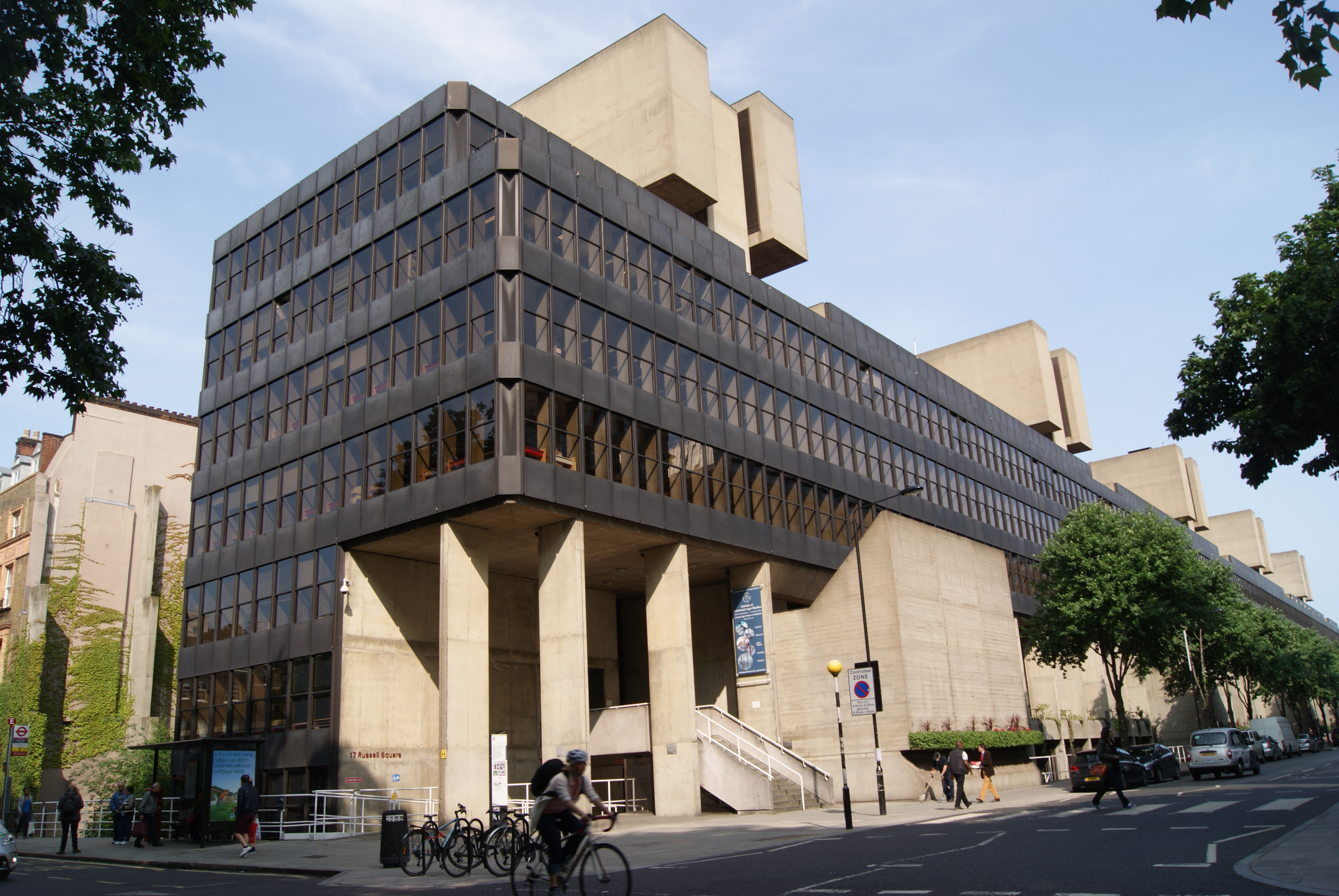 |
| Fig. 1: IALS, smuconlaw, https://en.wikipedia.org/wiki/Institute_of_Advanced_Legal_Studies |
Visit to the Guardian - 14th December 2015
On Monday 14th December, a group of the trainees
were fortunate enough to visit the headquarters of the Guardian Media Group and
meet with both the library and archive teams.
The Manchester Guardian was founded in 1821 by John Edward
Taylor and gained national and international acclaim under the editorship of C
P Scott who held the post of editor from 1857 to 1914. In addition, Scott
bought the paper in 1907 following the death of Taylor’s son and as we learned during
the course of our visit, the Scott Trust still maintains ownership of the paper
today. The paper moved to its current building in King’s Place near to King’s
Cross station in 2008, with the glass-fronted, open plan office space and
modern design marking a significant shift for the newspaper.
Upon arrival we were met by Philippa Mole, Acting Head of
Archive, who led us on a tour of the building, including the exhibition space,
reading room and the photographic and print archive stores. During the tour of
the archive, we were able to view a selection of the incredibly eclectic
objects kept within the stores. These ranged from negatives of the Beatles,
notebooks of renowned Guardian cartoonists, an early example of a ‘laptop’ (the
Tandy portable computer from 1983), Betamax film rolls and photographs of an
array of famous historical figures. The archive also contains, somewhat surprisingly
and initially rather alarmingly, an array of miniature coffins used to mark
significant moments over the course of the paper’s history (for example,
Philippa explained that a mock funeral was held in 1987 to mark the end of hot
metal printing at the newspaper. Crowds of staff turned out for the event, with
the pallbearers even donning top hats!)
In addition, Philippa also took time to explain the
day-to-day tasks involved with the running of the archive service. The archive
holds official records of both the Guardian and the Observer newspapers, as
well as acquiring material from people who have been associated with the
papers. As Philippa explained however, the archive does not actually contain
the newspapers themselves. She noted that the archive deals with a broad swathe
of inquiries both internally and externally from private researchers and
students. Additionally, the role of the archive team includes creating web
resources, writing blog posts, organising tours of the archive for staff and
arranging outreach activities.
The archive’s trainee Helen and Information Manager Richard
Nelsson, also took time to speak with us and explained their respective roles
within the archive and library teams. Richard provided a fascinating insight
into the role of the library department, explaining how the team conducts
background research for interviews, collates reports for publication departments,
produces content for both the print newspaper and online edition, create
timelines, attach corrections to articles in the newspaper’s internal database,
and compile the daily birthdays column.
Al three kindly answered several questions from the
trainees, with topics ranging from if there was a need to justify the existence of a
library team within a news media organisation, to electronic data subscription
services and the number of research enquiries the team receive. Philippa noted
that we were welcome to contact
her with any further queries we might have and kindly provided us all with a free
copy of the day’s newspaper!
Many thanks once again to Philippa, Richard and Helen for
devoting so much of their time to helping us get to know both a fascinating
archival collection and understanding the role of libraries and archives within
the media sector. The insight we gained was truly invaluable and will be of
great assistance as we all begin to embark on our careers into the sector.
For further information about the Guardian Archive and the
work of the Library Team see:
Senate House Library Visit - 10th December 2015
We started our visit to Senate House Library with an
introduction to the building’s history and architecture from Dr Jordan Landes,
history subject librarian. In the war years, Senate House served as the
Ministry of Information, and George Orwell’s wife worked there – and so, it is
said, came the inspiration for the Ministry of Truth in Nineteen Eighty-Four. It
was also in this building that the Welfare State was born, when, in 1942,
William Beveridge presented the report which was eventually to lead to the
establishment of the NHS. Above the entrance to the Macmillan Hall, and its
twin, the Beveridge Hall, the ceiling of the ground floor of the south block is
decorated with A-Zs, reflecting the fact that this was the first university
that did not require students to have a classical education.
We then made our way up to the 4th floor, which was originally the only floor open to readers, and where you would have received your item requests at your desk from a teenage boy in white gloves! Today things have changed somewhat, and all floors 4-7 are open access to readers, while the rest of the 19 floors hold the rest of the collection in closed stacks. The stacks themselves are load bearing and enable the tower to stay upright.
On the 4th floor is the opulently designed Goldsmith’s reading room – donated by the Worshipful Company of Goldsmiths to house their donation to SHL of the Library of Economic Literature, and which now holds the music collection. We also saw the cataloguing hall, whose irregular shape has had to be adapted to the purposes of a modern digital library. The first OPAC was introduced in the late 1980s, so from then on, all the acquisitions appear in the online catalogue. Before then though, the online record is a little patchy!
Dr Landes then took us through to the exhibition space. She explained that as subject librarian, a portion of her role is promotion of the collection – and one of the ways to do this is through exhibitions. As part of her librarianship degree, she actually took a module in museum studies, and so regularly finds herself employing the skills she learned there still, in her current role.
We next saw the history reading room, furnished with rows of beautiful Chesterfield sofas for the purpose of group study, but which has now become one of the quietest spaces in the library!
Dr Landes then told us more about subject librarianship. Her role encompasses collection development, which for Senate House, as the central Library of the University of London and the School of Advanced Study, is collection led, but in other libraries, particularly in HE libraries with their own students, is led by reader tastes and needs, as well as academic reading lists. This has implications for the cohesiveness of a collection, but has the benefit of being very user-focused. She also spends a lot of time in inductions and training, speaking to about 1,000 students every autumn. The last part of her job is subject promotion, which she does through a variety of activities like the exhibitions we saw earlier, as well as events like conferences and History Day.
Other libraries have changed their staffing models in recent years, and for some, the role of subject librarian no longer exists. King’s College for example no longer have subject librarians and rely instead on a liaison librarian for the whole faculty.
Although she is now a history subject librarian, Dr Landes has worked as subject librarian for fields as diverse as computer science and contemporary dance, and stressed that the role doesn’t necessitate an academic background in the discipline, as there is plenty of opportunity for professional development and training within a job. She also stressed the flexibility of librarianship as a whole and the opportunities for moving between positions themselves, particularly as a role as subject librarian might still encompass skills like cataloguing, digital media or user education. Furthermore, she completed her studies in the US, and found her degree was transferable and recognised in the UK.
We had all our questions answered and Dr Landes encouraged us to email her should we have anything else we’d like to know. She also mentioned that she’d be happy to offer anyone a day of shadowing should they wish to learn more about SHL and subject librarianship. A big thanks to her for the time she took to help us get to know a fascinating collection and a London icon, as well as getting some valuable insight into one of the career paths we might well later find ourselves on!
We then made our way up to the 4th floor, which was originally the only floor open to readers, and where you would have received your item requests at your desk from a teenage boy in white gloves! Today things have changed somewhat, and all floors 4-7 are open access to readers, while the rest of the 19 floors hold the rest of the collection in closed stacks. The stacks themselves are load bearing and enable the tower to stay upright.
On the 4th floor is the opulently designed Goldsmith’s reading room – donated by the Worshipful Company of Goldsmiths to house their donation to SHL of the Library of Economic Literature, and which now holds the music collection. We also saw the cataloguing hall, whose irregular shape has had to be adapted to the purposes of a modern digital library. The first OPAC was introduced in the late 1980s, so from then on, all the acquisitions appear in the online catalogue. Before then though, the online record is a little patchy!
Dr Landes then took us through to the exhibition space. She explained that as subject librarian, a portion of her role is promotion of the collection – and one of the ways to do this is through exhibitions. As part of her librarianship degree, she actually took a module in museum studies, and so regularly finds herself employing the skills she learned there still, in her current role.
We next saw the history reading room, furnished with rows of beautiful Chesterfield sofas for the purpose of group study, but which has now become one of the quietest spaces in the library!
Dr Landes then told us more about subject librarianship. Her role encompasses collection development, which for Senate House, as the central Library of the University of London and the School of Advanced Study, is collection led, but in other libraries, particularly in HE libraries with their own students, is led by reader tastes and needs, as well as academic reading lists. This has implications for the cohesiveness of a collection, but has the benefit of being very user-focused. She also spends a lot of time in inductions and training, speaking to about 1,000 students every autumn. The last part of her job is subject promotion, which she does through a variety of activities like the exhibitions we saw earlier, as well as events like conferences and History Day.
Other libraries have changed their staffing models in recent years, and for some, the role of subject librarian no longer exists. King’s College for example no longer have subject librarians and rely instead on a liaison librarian for the whole faculty.
Although she is now a history subject librarian, Dr Landes has worked as subject librarian for fields as diverse as computer science and contemporary dance, and stressed that the role doesn’t necessitate an academic background in the discipline, as there is plenty of opportunity for professional development and training within a job. She also stressed the flexibility of librarianship as a whole and the opportunities for moving between positions themselves, particularly as a role as subject librarian might still encompass skills like cataloguing, digital media or user education. Furthermore, she completed her studies in the US, and found her degree was transferable and recognised in the UK.
We had all our questions answered and Dr Landes encouraged us to email her should we have anything else we’d like to know. She also mentioned that she’d be happy to offer anyone a day of shadowing should they wish to learn more about SHL and subject librarianship. A big thanks to her for the time she took to help us get to know a fascinating collection and a London icon, as well as getting some valuable insight into one of the career paths we might well later find ourselves on!
Trainee Profiles 2015-2016
Institute of Historical Research Library
Hello! I’ve been the Library Graduate Assistant at the
Institute of Historical Research for just over 3 months now, so now that I have
settled in I felt it was time to introduce both myself and the Institute of
Historical Research Library.
Located within Senate House, the IHR is a reference only
research library consisting of a collection of published primary sources which
cover the history of Western Europe and its colonial history from the fifth
century to the present. In addition, the library contains significant holdings
for the United States, Latin America and Asia. The library team is made-up of four
permanent members of staff and two who work across both Senate House Library
and the IHR Library.
Joining such a small team has been an incredible opportunity
as I have been made to feel so welcome and have been asked to participate in an
incredibly diverse range of tasks. This has so far consisted of helping to
draft a user survey, researching and writing collection guides and blog posts,
updating the IHR Library’s website and Facebook account (please like and follow!), helping
with event promotion, ordering new acquisitions for the German collection, researching
new shelf and floorplan signage and assisting with the creation of training
materials for online resources.
This has been in addition to the day-to-day tasks of working
in the library: book retrieval from the library’s onsite store in the upper
echelons of Senate House tower (incredible view but can be just as scary as it
sounds!), re-shelving, dealing with user enquiries, updating the new book shelf
and processing inter-library loans. Experience of all of these diverse tasks has
definitely made me realise that I never fully appreciated the range of jobs
incorporated under the term ‘librarian’ before!
The diverse work and the comprehensive training I’ve
received has been of immense help to me as I had no prior experience of working
in a library. Before joining the IHR as library trainee, I completed my
undergraduate and postgraduate degrees in History at the University of
Edinburgh. The position at the IHR was therefore ideal for me (combining my
love of books and history) but I was unsure if I would have the relevant skills
required. Having worked in retail throughout my studies, I was pleasantly
surprised to learn that the customer service skills I had developed were of
value to the library profession. Hence the move to London from Edinburgh and a
seemingly vast change in climate – London seems almost tropical in mid-winter
in comparison!!
I’m thoroughly enjoying my time at the IHR and cannot
believe how quickly the year is flying by. I cannot wait to start visiting
other libraries as part of the series of visits that take place during the
trainee year. I feel I am learning all the time and have already gained an
invaluable insight into the world of librarianship. I would urge anybody to
consider the Graduate Trainee programme!
Siobhan Morris
Library
Graduate Trainee, Institute of Historical Research
Welcome to the Trainees of 2015/16
Hi All,
I'm Mike and you'll be seeing me next week at the trainee welcome afternoon here at the Institute of Historical Research. I know some of you have already looked through this blog but this is the year to put your own stamp on it. The types of post included in previous years have been:
See you soon.
I'm Mike and you'll be seeing me next week at the trainee welcome afternoon here at the Institute of Historical Research. I know some of you have already looked through this blog but this is the year to put your own stamp on it. The types of post included in previous years have been:
- Trainee Profiles
- Blogs about the various visits and training sessions
- Any useful information about the various library school options.
See you soon.

3 months in, nearly
It's been 2 and a half months since I started my traineeship at the Institute of Advanced Legal Studies and it has been far from what I expected. To be honest, I didn't really know what to expect as this is the first time I've worked in a library. I am from a retail background, having worked in retail for 5 years, so it was difficult for me to imagine anything different. In addition, I knew very little, if not nothing, when it came to law.
However is has been an enlightening couple of months. I've learned about checking in new serial books onto the millennium software, the different terminology used when referring to law books and law reports etc. and the different departments that work behind the scenes.
I could go on, because I'm learning something new everyday. Whether it's to do with the databases used to find material or the way in which students use the resources.
I'm glad I started with an open mind and that it is completely different to what I was doing before. I took the leap to do something that I had wanted to do for a long time and I'm really enjoying it.
Welcome
Hello all. I just wanted to welcome our new crop of library trainees based here in London (which has continued to grow, including now this year trainees from the Bank of England). I'm Mike from the Institute of Historical Research (you'll see me a few times throughout the year, but I'll mainly be an annoying email presence sending you Doodle Poll invites to various visits throughout the year!) Anyways I hope you'll all find this blog useful and maybe even entertaining in parts and feel free to make it your own for the coming year as previous trainees have done. N.B. One thing you'll also find useful is the list of coming visits which will begin to be updated soon, so eyes peeled.
See you soon.
See you soon.
Visit to Cambridge Libraries
On Thursday, 17 July, five of us were
lucky enough to visit several libraries in Cambridge and meet their graduate
trainees. Last year’s London trainees did a similar trip to Oxford, and I hope
future years’ trainees will get this opportunity as well. Not only was it nice
to get out of London and see another city, we also were able to learn about the
unique features of working in libraries that are often a mix of centuries-old
books and architecture, and very modern buildings and services. In some ways, I
found the Cambridge libraries to be a lot like my workplace, the Courtauld
Institute’s Book Library.
 |
| The outside of the Wren Library, Trinity College |
Trinity College
We began our day at 11am at Trinity
College. The graduate trainee, Harriet, was kind enough to come in on her day
off to give us a tour. She walked us through the impressive First Court, past
the steady stream of awed tourists. Of course, most of the students were
already finished for the academic year, and there were only a few dotted around
the grounds and the library. We entered the library from the newer section and
wound our way through the stacks and student study areas to the entrance of the
impressive Wren Library, completed in 1695. This was certainly the most typical
example of what one would expect of an old Cambridge college library; a
beautiful arched ceiling, scholars working silently, and shelves full of antiquarian books and manuscripts. Within the display cases on either side of the central
aisle were gems from the collection such as a first edition from Sir Isaac
Newton (with an annotated title page adding the ‘Sir’ once he was knighted),
A.A. Milne’s manuscripts of his Winnie-the-Pooh books, and a special exhibition
created by Harriet and other library staff focussing on the college and library
during WWI.
 |
| St. John's College |
St. John’s College
Our next stop was St. John’s College,
where we were met by graduate trainee Charlotte. Despite the similar look of
the college itself, the ‘Working Library’ as it is called, was very different
from the older libraries of Cambridge. Built in 1994, the Working Library has
all the modern features one would expect from a university library. For
instance, students can gain access 24 hours a day, using their cards to gain
entry outside staffed hours. The building is full of natural light and feels
very spacious, but also allows for quiet, secluded study spaces. Looking around
their new acquisitions displays and audio-visual collection, I was impressed
by their large selection of both academic and non-academic items. The Working
Library is connected to the ‘Old Library’, staffed by a Special Collections Librarian
who supervises the Reading Room on the ground floor. The Old Library’s first
floor is smaller than the Wren, but just as impressive. It is lined with
beautifully carved shelves, which even have the old library catalogue hand-written on
to fold-out panels on the front of each bay, a snapshot of the library as it
once was. Each graduate trainee is able to create an exhibition, and
Charlotte’s, which is entitled ‘Blancmange to make, Blisters to draw’, has been
receiving attention from the media thanks to the publicity help of her
colleague. Having done her masters dissertation on early modern medical
recipes, Charlotte decided to curate the exhibition on this topic.
 |
| The Old Library, St. John's College |
Christ’s College
Our last stop before lunch was
Christ’s College. Graduate trainee Lucy first took us to the separate Law
Library, nestled on the side of the Porter’s Lodge, and then to the main
Working Library. Built in the 1970’s, the Working Library is less
architecturally stunning than the first two libraries, but they offer services
such as ‘Squash O’Clock’ where library staff provide squash and biscuits for
students near the library entrance during exam times. One of the features of
the collection is the music hire library, one of the largest collections of
borrowable music in Cambridge. The Old Library was designed by architect G.F.
Bodley in the 1890's, although a small section dates from 1505 when the college
was founded. The collection includes six first editions of Paradise Lost by
Christ’s College alumnus John Milton, and a first edition of On the Origin of
Species and letters from alumnus Charles Darwin to his cousin, William Darwin Fox. Lucy’s
exhibition is in the Old Library and explores the link between the college and
American alumni and investors. Besides the American flag bunting decorating the
room, we were also shown unique library items such as sixteenth-century
mummified rats, which were found in the walls during a library renovation. The
rats were kept for anatomical study because of their exceptionally long tails, which indicated they were genetically interesting specimens.
On that appetising note, we headed off
in search of lunch.
Pembroke College
Our first stop after lunch was
Pembroke College’s libraries. The Old Library was designed in 1875 by Alfred
Waterhouse (architect of the Natural History Museum in London), and the modern
additions such as the Law Library and Yamada Reading Room were added in 2001 by
local architect Tristan Rees-Roberts. Graduate Trainee Sarah took us through
the library, beginning with the newly added collection from the library of art
historian Tom Rosenthal. The beautiful stained glass of the old and new
libraries, and the views of the peaceful, leafy ground make for the ideal place
to read and study. I felt that this library presented the best mix of old and
new of any of the libraries. The Yamada Reading Room is a real gem, with modern
stained glass windows on one side featuring poems from former Pembroke College student
Ted Hughes.
The Classical Faculty Library
Our second visit of the afternoon was
to the only faculty library on our list, the Classics Library. Graduate trainee
Emily, who also kindly organised our Cambridge visit, showed us the modern
building and its collection. Although there were less of the interesting
architectural features and rare books of the college libraries, Emily’s tour
gave us the best sense of the day-to-day workings of a Cambridge library. The
first floor of the Classics building holds the Museum of Classical Archaeology,
which features casts of a multitude of classical sculptures, an exhibition of
modern art inspired by the casts, and lots of features for school visits.
 |
| Newnham College |
Newnham College
Our final stop was Newnham College,
originally the only college or faculty library women were allowed to use, and currently
still a women-only college. Unfortunately, the graduate trainee at Newnham
library, Meriel, was not able to be there on the day, so we were kindly offered
a tour by the library assistant on duty. The ‘old’ part of the library is
actually relatively new, as it was built in 1897. It was expanded in 2004 and
is now a graceful mix of old and modern features. There are study spaces with
views out through the large arched windows of the old library on to the
beautiful grounds. In addition to an impressive collection of books from all
disciplines, the library also has turn-of-the-century illustrated children’s
books. I only glanced the spines of some of these on a closed access shelf, but
even those were beautifully embossed. Meriel’s exhibition is on the theme of
‘All creatures great and small’ featuring zoological and botanical
illustrations. As an illustrator, the Newnham’s collection really appealed to
me, and I was especially drawn to a small selection of ukiyo-e prints hanging on the walls of a darkened hallway. Our tour
guide finished by showing us the grounds and pointing us in the direction of
the old laboratories. Having had a look at this building, we headed back
towards the city centre and met some of the Cambridge graduate trainees.
Thank you to Mike and graduate trainee Emily for organising the visit, and to the Cambridge graduate trainees for giving
us tours!
Photos by Bobbie Winter-Burke
Christ’s College Library
The Classical Faculty Library
Newnham College Library
Pembroke College Library
St. John’s College Library
Trinity College Library
Trainee Profiles 2013-2014
City University London
Michelle Kaczmarek
Michelle Kaczmarek
Hello, I’m Michelle!
I’m one of the two trainees at City University London and I
thought, as I’m at least three quarters of the way through my year here (how
time flies!), it was about time I introduced myself and reflected a little on
my experiences as a library graduate trainee…
I came to the traineeship straight out of university. I
haven’t always wanted to be a librarian – in fact I’ve never really known what
I’ve wanted to do! When I was eight I told my parents that I’d quite like to
stack shelves at Tesco when I grew up – needless to say, no matter how many
times I try to explain that a librarian’s role is a little more varied, they
still joke that I must be living the dream with all those books to shelve…
Anyway, after completing my Bachelor’s degree in Combined
Arts at Durham University, I flirted for a while with the idea of pursuing a
career in art history academia; I embarked on a research Master’s degree and
spent a year submerged in books about Picasso and Parisian cabaret. I can’t
deny that I loved feeling a little bit like an art history detective, delving
deep into the subject and uncovering unexpected connections. My experience of
postgraduate research, however, made me realise that it wasn’t the specific
subject that I loved, but the research process itself. A career in
librarianship seemed to me to be the best way to support and inspire research
and learning in all subject areas. I applied to traineeships and was lucky
enough to secure a position at City University – cue the rather overwhelming
transition from medieval Durham to Central London!
The City University traineeship programme is split over two
sites; my first six months were spent working at Cass Business School and in
March I moved to the main University Library. It’s been a great opportunity to
experience and compare work in a large university library as well as a smaller
departmental library and I’ve definitely got a greater understanding of
academic library operations by seeing how the two interact. I’ll admit that, as
an art history graduate, the prospect of working in a business school library
didn’t sound like my cup of tea. Thankfully I was proven wrong; while I didn’t
emerge from the six months with a new-found understanding of financial markets,
I felt that I at least had more awareness of the area and could offer valuable
advice and educational support to those who did choose to pursue the topic. My main
day-to-day duties at Cass involved processing books (new books, location
changes, withdrawals and repairs), dealing with membership and access requests,
and assisting with enquiries on the service desk; alongside this, I helped out
with various other jobs and projects as and when they came along (editing
online reading lists, ordering books, writing up information for a database app,
etc.). My training at Cass also gave me a working knowledge of key financial
databases such as Bloomberg – skills which I’m sure will be useful in the
future.
With only five members of full-time library staff, my work
at Cass was quite different from the Main University library. While I became
involved in most areas of the library’s day-to-day operations at Cass, I am now
working in the Copyright and Digitisation department. This involves fulfilling requests for digital
course readings – making sure that the request is within the limits of
copyright, finding and scanning the extract, and making it available to
students via Reading Lists Online – as well as enquiry work on the service desk
and a few other bits and bobs. While I was initially quite nervous about
moving, everyone at both sites were so friendly and welcoming that it turned
out to be a really positive thing; overall, I think this change to a more
specific area of library work has ensured that I’ve continued to learn new
things throughout the whole year.
My experience of being a trainee at City has been
overwhelmingly positive. Before I started I wasn’t really sure whether working
in library services was something I definitely wanted to do or what the role of
a librarian even really involved! As I’m sure has been the case in many
institutions, this year has not been an easy one for City as cuts in spending
force staffing reviews and job insecurity. I feel like this has been a valuable
experience, exposing me to some of the realities of working in the field in
harsh economic situations. It acted as a reminder to me that libraries must
(and do) continue to prove their value to society and I admire the
professionalism of my colleagues in working through it. I continue to enjoy my
traineeship, especially working with students directly to support their
research and education. My experiences so far this year have opened my eyes to
the varied roles that the term “librarian” encompasses in an academic
institution, and I urge anyone considering a career in librarianship to visit
as many libraries as they can – and not just the obvious ones – librarians are
everywhere!
As for me, I’m enjoying
my last couple of months at City and looking forward to the future. I hope to
begin studying for the Library and Information Studies Master’s next year and
have applied to courses in London but also in Canada! I’m happy with the
experience and skills I’ve picked up this year and I’m excited to see where the
next stage of my library career takes me!
Subscribe to:
Posts (Atom)